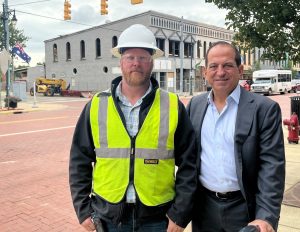
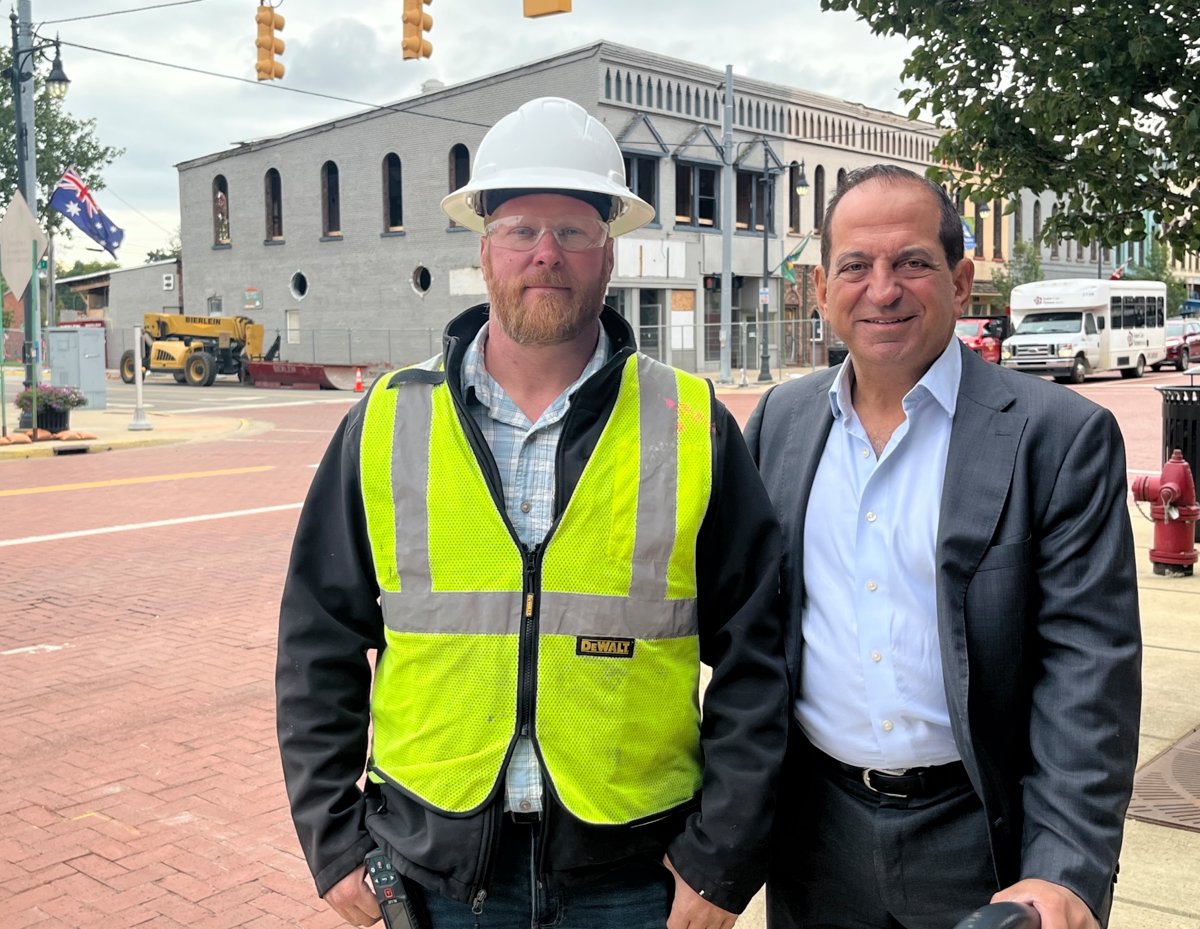
Saginaw-based Shaheen Development, a family-owned real estate company led by Shaheen, is serving as owner’s representative. Shaheen is an Albion College graduate.
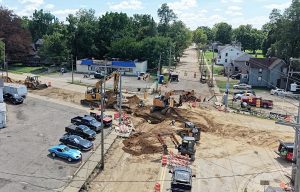
Dave Diemert, an Albion resident and Albion College graduate who serves as a project point person, described the work as “selective demolition.” He said diamond saws are being used to separate what is being removed from what will remain, while new lumber provides reinforcement and a framework for protective covering.
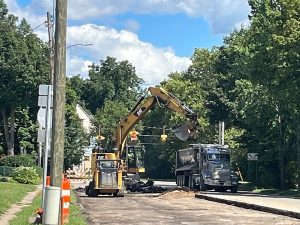
Last week, old brick walls, interior rooms and new lumber were visible through openings at the rear of the block, where equipment from Midland-based Bierlein Companies was working.
Plans call for exposed brick interiors and architectural details that reflect the block’s historic character. The commercial spaces will average about 1,000 square feet and be prepared in “white box” condition for tenants to finish. Residential leasing is anticipated to begin in spring 2027, with a fall 2027 opening planned.
In the project’s press release, Albion Mayor Victoria Garcia-Snyder called the redevelopment “truly transformational for our community.”
The construction is the latest chapter in a longer story. An Oct. 26, 2018, Recorder article, “Big Albion Plan to Revitalize Downtown Brought to the Public,” described a considerably broader plan: 29 renovated storefronts and 52 new apartments. Amy Deprez, then president and CEO of the Albion Economic Development Corporation, said “three groups are coordinating the financing for the BAP efforts” — ARC, ACE Investment Properties and Albion College. Bill Dobbins, then ARC president, owned ACE Investment Properties. Shaheen was ARC vice president, and Mauri Ditzler was Albion College president.
Eight years later, the financing structure shown publicly is different. A “Capitalization and structure” slide Shaheen showed council listed “Albion College — 44%” and “Albion Reinvestment Corp. (MEDC) — 56%,” both connected to OZB Phase I, LLC. The slide also showed $5 million in MEDC funding, $2 million in bank debt and $300,000 from the Albion Community Foundation toward the $11.3 million project.
The presentation was not included with meeting materials posted online; The Recorder photographed several slides as they were shown. Asked about the College’s 44%, Shaheen referred the question to Albion College.
Albion College President Wayne Webster wrote Sunday that the College is “simply an investor,” using some endowment funds as allowed by its investment policy along with gifts made specifically to support the College’s investment in the project.
Webster also pointed to housing. “We view having more housing as an asset to our faculty and staff and a more vibrant downtown as an important part of attracting students to our campus,” he wrote.
For now, the most visible change is on Superior Street. Behind the long construction fence, walls and rooms hidden for generations are temporarily exposed as the old block is prepared for another use.