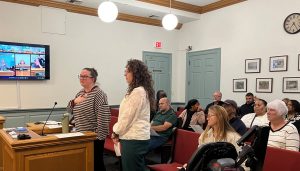
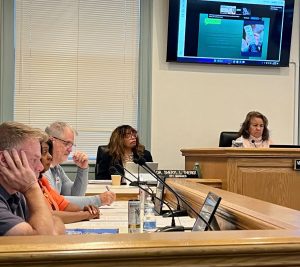
The presentation and discussion occupied roughly the first half of Monday’s meeting, as council members and city officials considered both the technology’s investigative value and questions about privacy, access, and possible misuse.
Phipps said Albion has 20 Flock cameras covering gateway routes into the community, recording both incoming and outgoing traffic. He said the system had recorded about 4.8 million vehicle observations year to date.
“That is a lot of vehicles, and that is a lot of data,” he said, adding that he understands why people may be concerned about it.
Phipps gave several examples of investigations in which the cameras provided leads. In one Tractor Supply larceny, police started with little more than a description of a red pickup. Phipps said Flock helped officers identify a license plate and the vehicle’s make and model, allowing them to work with Spring Arbor police to continue the investigation.
In another case, Albion police received information about a vehicle connected to a 2025 Battle Creek kidnapping and home invasion that was traveling east on I-94. Phipps said an Albion sergeant used Flock to identify the vehicle and, after receiving permission to act outside the city’s jurisdiction, stopped it on I-94. Two people were arrested. Phipps also said Flock has been “instrumental” in the investigation of a recent Albion shooting, although he did not discuss details of the ongoing case.
The cameras record license plates and vehicle characteristics, but Phipps said they do not use facial recognition, identify drivers or passengers, detect speed in Michigan or issue speeding tickets. He described information produced by Flock as an investigative lead rather than as evidence that, by itself, establishes guilt.
Phipps said the rules governing searches and the length of time information is retained are changing. The system previously allowed data to be retained for up to 30 days, he said. Michigan lawmakers have considered legislation reducing that period to 14 days, while Flock is moving toward seven days.
Phipps said most searches are conducted within 24 to 48 hours, making the shorter period workable. He also said an offense type is required when conducting a search and that Flock now wants users to provide a case number.
Flock has appeared in The Recorder in recent weeks from different perspectives. Publisher Mike Wilcox raised privacy and civil-liberties questions surrounding searchable license plate information in an opinion column.
Questions Monday included not only what the cameras collect, but what prevents an authorized user from misusing the information.
In a hypothetical example about possible misuse, Mayor Pro Tem Andy French asked what would prevent a police officer from using the system to track a former girlfriend for personal reasons. Phipps said activity within the system can be traced to individual users.
“There’s a digital footprint of everything that is done within that system,” Phipps said.
He said similar auditing is available for other databases used by police and could be reviewed if the department received a complaint about improper access.
Phipps also noted that law enforcement has long had access to databases containing information considerably more personal than a Flock vehicle observation, including names, addresses, dates of birth and vehicle registrations. Flock, he said, photographs a vehicle traveling on a public roadway.
City Attorney Cullen Harkness addressed the legal distinction between privacy concerns regarding a large, searchable system and the expectation of privacy in a publicly displayed license plate.
Harkness cited longstanding state and federal case law holding that motorists do not have a reasonable expectation of privacy in license plates openly displayed on vehicles.
“I could literally go sit out in a lawn chair at the edge of town and take down the same information that the Flock cameras do and compile it into a database,” Harkness said.
What technology changes, he said, is how quickly and systematically that can be done.
“The only thing that Flock has done — it’s an evolution of technology,” Harkness said.
Councilmember Donivan Williams also asked about concerns that Flock information could be used by U.S. Immigration and Customs Enforcement (ICE.)
Phipps said ADPS would assist when someone is wanted on a violent warrant, but said the department generally would not help another agency simply determine whether someone lives in Albion if the agency could not articulate why it needed the information.
“Discretion is the most powerful thing we have, and we need to use it wisely,” Phipps said.
Mayor Victoria Garcia-Snyder placed the discussion in the broader context of changing technology.
“Technology has evolved not only for law enforcement but for any other agency, any other department, any other institution,” Garcia-Snyder said. “How we use that technology is a different story.”
She said policies should clearly establish appropriate uses of the technology as well as consequences for misuse, and expressed confidence that ADPS was using Flock for its intended purposes.
Albion entered its agreement for the cameras in December 2023. City documents list an initial cost of $73,000 followed by annual billing of $60,000. Phipps told council the system is currently renewed yearly.
Councilmember Vivian Davis asked whether Phipps could provide the council with periodic reports on the system’s effectiveness. Phipps said he could provide the information presented Monday “and probably even more.”
Garcia-Snyder characterized Flock as potentially “a long-lasting conversation” before council moved on to its next agenda item.