"You Told Us to Demo It": Inside the Study Session Behind Albion's Downtown Decision

By Maggie LaNoue – Contributing Writer  – May 15, 2026

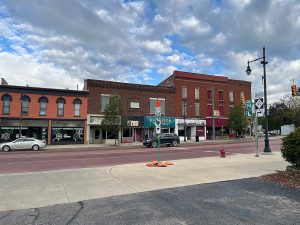
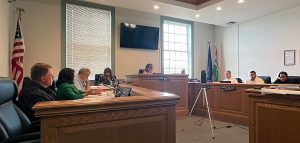
Before the Albion City Council voted on May 4 to acquire the fire-damaged building at 100 S. Superior Street, city leaders, staff members, preservation advocates, and residents spent more than an hour in a study session weighing a decision that carried a hard deadline — accept the $1 transfer from the Calhoun County Land Bank Authority by May 5, or the building would face demolition under a federally funded blight elimination program.

City Attorney Cullen Harkness told council he had consulted environmental attorneys regarding the proposed acquisition and said they strongly advised against taking ownership of the building without a Phase 2 environmental assessment.

Harkness also told council that the demolition process had not originated with the Land Bank. “The way that this all started was code enforcement,” he said. “SAFEbuilt sent an order on behalf of the city to order the Land Bank, and so the Land Bank in moving forward with the demolition was acting on our directive to take the buildings down.”

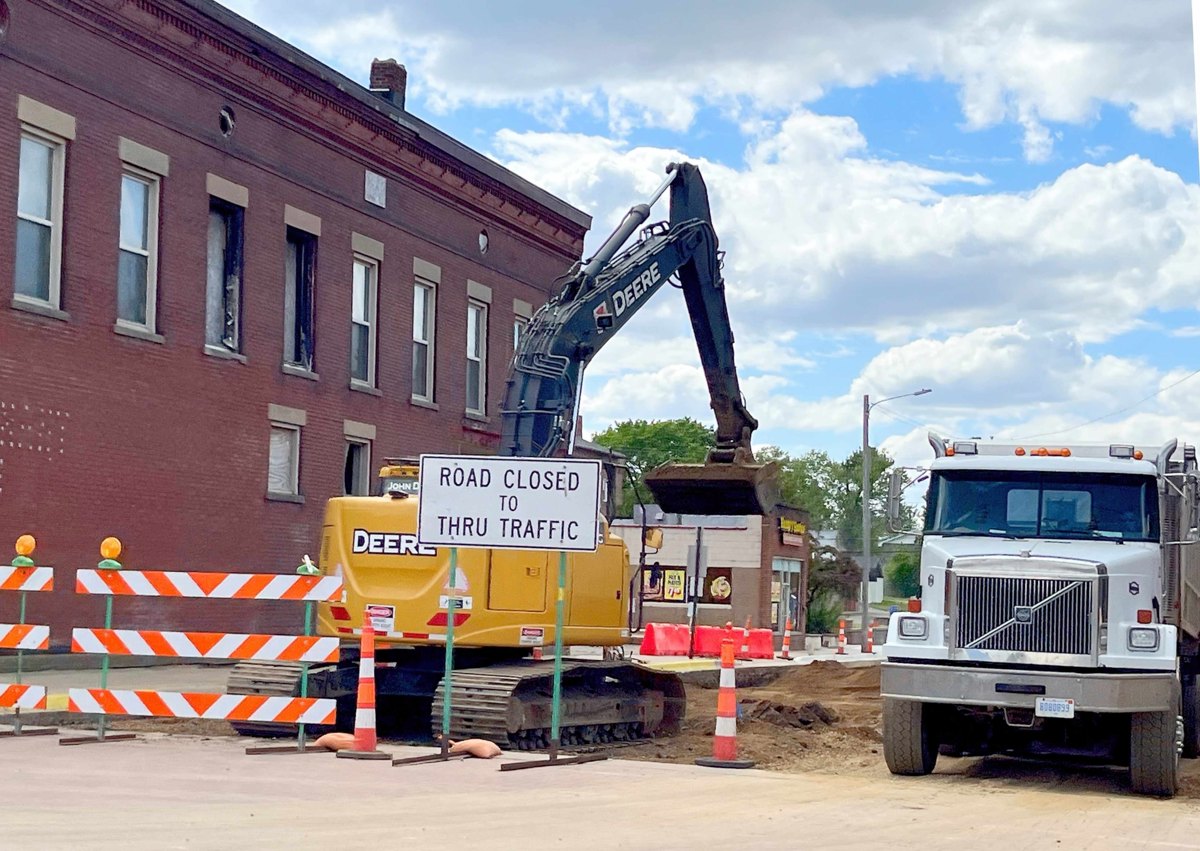
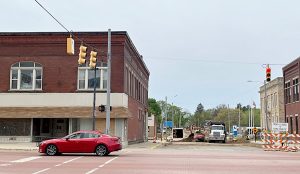
Road construction
Road construction continues along Cass Street beside 100 S. Superior Street in downtown Albion during May 2026. Speakers during the May 4 study session repeatedly referenced the financial pressures tied to infrastructure upgrades, environmental requirements and redevelopment planning across the city.

Speakers during the study session said the city would have approximately 45 days following closing to conduct Phase 2 environmental testing and complete a Baseline Environmental Assessment (BEA) for submission to the Michigan Department of Environment, Great Lakes and Energy (EGLE).

Environmental consultant Dave Van Haaren of Triterra said the process could become complicated because portions of the fire-damaged building may still be unsafe to fully access.

“There’s a very strict deadline,” Van Haaren said regarding the BEA process, while also noting that he had begun informally exploring whether EGLE might allow flexibility if stabilization work was needed before complete testing could safely occur. He cautioned, however, that no formal extension process had been confirmed.

After the meeting, Albion Economic Development Corporation President and CEO Debbie Kelly confirmed that the Brownfield Redevelopment Authority plans to fund the Phase 2 environmental study on behalf of the city. Kelly said the study must still be completed and submitted to EGLE within 45 days of closing and that reimbursement would depend on future redevelopment plans and approval of a Brownfield Plan.

Separately, Council Member Jim Stuart, who also serves on the Calhoun County Land Bank Authority board and is a property owner and real estate developer in Albion, was among those who raised early preservation concerns that helped prompt that response.

Costs discussed during the study session fell into several categories. The City’s immediate obligations upon closing include approximately $1,700 in closing costs and possible additional title expenses. A Phase 2 environmental study is estimated at $20,000. Looking further ahead, preliminary stabilization estimates range from approximately $50,000 to $75,000, while broader redevelopment costs were discussed as exceeding $1 million — figures that speakers noted would depend heavily on grant funding, brownfield tools, and private investment.

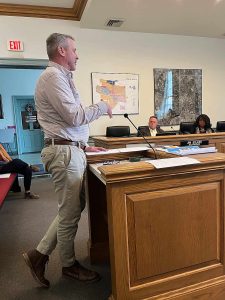
Dave Van Haaren of Triterra
Dave Van Haaren of Triterra discusses environmental due diligence, Phase 2 assessment requirements and EGLE timelines during the Albion City Council study session on May 4 regarding the proposed acquisition of 100 S. Superior Street.

Public Safety Director Aaron Phipps also addressed concerns about the condition of the building and the risks associated with entering unstable structures.

“Nobody’s life is worth a building,” Phipps said during the discussion.

Other speakers cautioned the council against making decisions based primarily on emotion or assumptions that future partners would automatically have the capacity to absorb redevelopment risks. During public comment, Downtown Development Authority Chair Emily Verbeke said the city had been placed in a difficult position under compressed timelines and warned that “everyone’s stretched thin” as Albion continues balancing multiple redevelopment and infrastructure challenges.  She urged the council to consider the long-term financial implications alongside preservation goals.

At the same time, many speakers urged the council not to focus solely on immediate costs or demolition timelines.

Council Member C.J. Frost described the issue as larger than a single structure, saying the discussion involved “who makes decisions about what our community looks like today and tomorrow.”

Frost argued that local ownership would allow Albion greater control over future redevelopment rather than leaving decisions to outside entities or absentee owners.

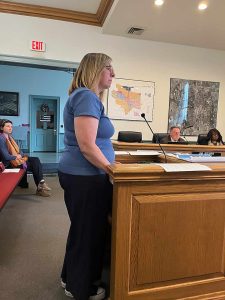
Krista Trout-Edwards
Calhoun County Land Bank Authority Executive Director Krista Trout-Edwards answers questions during the May 4 Albion City Council study session regarding the future of 100 S. Superior Street and environmental deadlines tied to the property.

Mayor Victoria Garcia Snyder acknowledged the difficulty of the decision and said the issue had weighed heavily on her.

“I see both sides,” Snyder said, adding that she believed community leaders, grant writers and redevelopment partners would continue working to identify resources to stabilize the building and pursue future redevelopment opportunities.

Several speakers referenced earlier preservation projects in Albion as examples of buildings once viewed as difficult or unrealistic to save.

Historical Society President Celeste Connemacher spoke emotionally about the long-term consequences of demolition decisions, referencing the Gardner House and other preservation efforts that eventually became valued community assets.

“Once you say too bad, let it go — that’s it,” Connemacher said. “It cannot be recaptured.”

The discussion also highlighted the increasing complexity facing small communities attempting to balance preservation goals with aging infrastructure and limited financial resources.

Public Works Director Jason Kern, speaking in the context of unexpected costs discovered during ongoing road construction, noted that Albion continues facing expensive infrastructure demands. “Our problems are not going to stop,” he said.

Calhoun County Land Bank Authority Executive Director Krista Trout-Edwards and other representatives attended the study session and answered questions regarding the property, environmental process, and demolition timeline tied to federal funding deadlines. Speakers also discussed how communication gaps and leadership transitions over recent years may have complicated earlier conversations about the future of the building.

Trout-Edwards was direct about the Land Bank’s position regarding the demolition. “We’re not going to walk away and not demo it because we can’t,” she told council. “You told us to demo it, number one, and our insurance company has said you cannot not demo it. We are in the same boat on liability.”

The study session repeatedly returned to broader questions surrounding Albion’s historic district, redevelopment expectations, and the future character of downtown Albion. Some speakers suggested the debate may prompt future conversations about preservation priorities and whether additional local planning or preservation tools may eventually be considered.

By the end of the evening, the discussion had evolved far beyond a single vacant structure into a broader public conversation about environmental risk, redevelopment, local control, financial responsibility, and the future direction of downtown Albion. While some speakers emphasized historic preservation and community identity, others urged caution regarding liability, infrastructure pressures, and the long-term obligations the city may now face.

The fire-damaged building at 100 S. Superior Street is now owned by the city. What happens next will depend on the partners, funding, and decisions that follow, questions the study session raised but did not fully answer.

Support this site that features Albion, Michigan. 
Click here or on a picture to read the legends and to find out how to order cards or prints.