17 minutes, two major votes: Special meeting advances Austin School Lofts and Haven Road Bridge

By Maggie LaNoue – Contributing Writer  – March 27

The Albion City Council approved the second reading of Ordinance No. 2026-04 supporting the proposed Austin School Lofts redevelopment during a special meeting Monday night, March 23, allowing the project to move forward ahead of an April 1 state housing funding deadline.

The ordinance establishes a Payment in Lieu of Taxes (PILOT) agreement for the development at 709 and 713 N. Clinton Street. Under the PILOT structure, the project would pay an annual service charge equal to 7 percent of shelter rents instead of traditional property taxes, for up to 45 years, contingent on receiving financing.

The development depends on Low-Income Housing Tax Credits (LIHTC), a competitive program administered through the Michigan State Housing Development Authority (MSHDA). The application deadline for the current funding round is April 1, prompting the need for council action before that date.


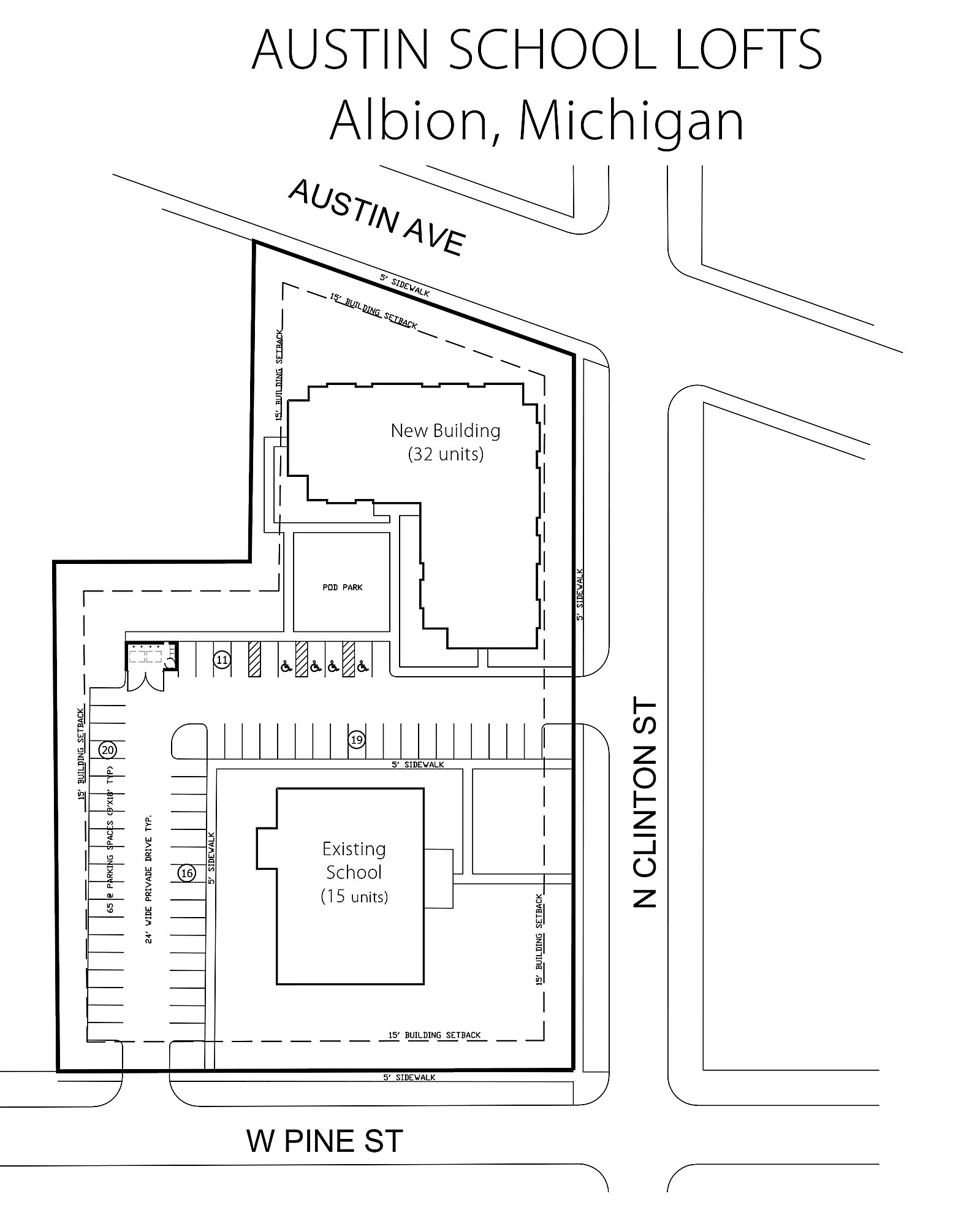
Austin School Lofts development at North Clinton Street
A site plan presented to Albion City Council shows the proposed Austin School Lofts development at North Clinton Street, including conversion of the existing school building into 15 apartments and construction of a new 32-unit residential building on the same property. Source: Pivotal Housing Partners (adapted by albionmich.net)

At the March 16 first reading, Council Member CJ Frost voted against the ordinance, citing concerns about the terms of the agreement rather than the project itself. Frost said he supported rehabilitating the historic building but questioned whether the city had negotiated the best possible deal. After researching Pivotal Housing Partners’ other projects, he argued that Albion was being offered less favorable terms than the developer had agreed to elsewhere — a 7 percent service charge over 45 years compared to what he described as a typical 9 percent rate over 30 years. “I don’t know why we push these so quickly and give away the farm,” Frost said, “when I don’t think that’s necessary.” The ordinance passed its first reading over his objection. Frost was not present for the second reading vote, which was unanimous among the six members present. He was excused at the end of the meeting.

Legal counsel was provided remotely by Jonathan Fowler, Associate Attorney of the Harkness Law Firm, who attended the meeting online.

Developer Dane Truscott of Pivotal Housing Partners was in attendance for the second reading, following earlier discussions held on March 2 and March 16. The special meeting itself was brief and focused, reflecting the limited agenda and the approaching funding deadline.

The Austin School Lofts plan calls for redevelopment of the long-vacant former elementary school into 47 apartments, including 15 three-bedroom units within the historic building and 32 units in a new structure on the same property. Plans presented to council show the historic building retained alongside new construction, with parking and site improvements included.

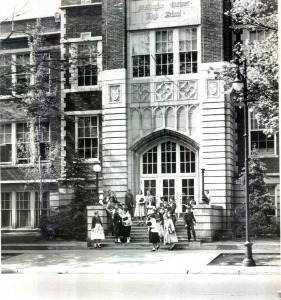
City officials have described the project as an opportunity to return a long-vacant building to productive use. Former Interim City Manager Doug Terry said earlier discussions framed the redevelopment as a way to “take a building that has sat vacant for 30 years and turn it into productive use.”

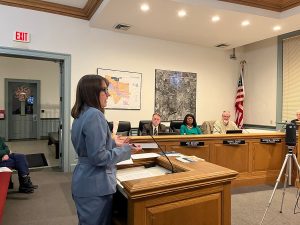
Suzannah Deneau of Wightman
Suzannah Deneau of Wightman addresses Albion City Council regarding a bridge grant application during a special meeting March 23. Council approved a resolution supporting the project with a 10 percent local match.

Council Member Donivan Williams previously connected the project to broader economic trends, noting that additional residents can contribute to state-shared revenue and local economic activity, while helping address population decline that has reduced Albion from about 12,000 residents to fewer than 8,000.

Earlier presentations also indicated that Albion scores well under the state’s housing funding criteria, with developers noting that location-based factors can make certain communities more competitive for investment. Multiple housing proposals now under consideration reflect that broader trend.

In addition to the housing ordinance, the council approved Resolution No. 2026-14 supporting a grant application for the replacement of the Haven Road Bridge over the south branch of the Kalamazoo River near the waterfall at Victory and Rieger Park. The project would also replace the water main running along the bridge structure. Suzannah Deneau of Wightman explained that the updated proposal includes a 10 percent local match of $296,369.50 toward a total project cost of $2,963,695.00.

The city submitted a similar application last year using a 5 percent local match, which was not approved. Deneau said the higher match improves the city’s competitiveness for state funding. The Michigan Department of Transportation Local Bridge Program distributes roughly $50 million annually in state and federal funds through a competitive regional process, with applications submitted years in advance to match the funding cycle. The city’s application targets FY 2029, meaning the project would move forward in the coming years if awarded.

Council members also discussed how to better communicate the city’s priorities, with Council Member Jim Stuart suggesting a simpler, more concise approach in addition to existing planning documents. City Manager Sheryl L. Theriot said she plans to meet individually with council members and may bring the topic back for further discussion at a future study session if needed.

During public comments, Theriot noted that her second day on the job included responding to a water line break and highlighted a new construction update page on the city’s website where residents can track project progress.

A similar PILOT agreement for affordable housing in Albion sparked public debate last year over whether tax incentives for developers are fair to existing property owners. The Washington Gardner redevelopment is also expected to seek funding through the same LIHTC program and would provide approximately 61 new affordable housing residences along with community amenities.

Monday’s special meeting lasted just 17 minutes, but the decisions made touched on projects years — and in some cases decades — in the making. The Haven Road Bridge has navigated multiple funding cycles. The Austin School has sat vacant for 30 years. The Washington Gardner redevelopment adds another chapter to an ongoing effort to rebuild Albion’s housing stock. What positions Albion to compete for state and federal dollars on multiple fronts is, in part, the economic reality its residents live with every day. With a median household income of roughly $40,000 — about half the Michigan average — and a poverty rate nearly double the state’s, the city qualifies for funding programs designed to help communities that need it most. Monday’s votes were quick. The work behind them was not.


Washington Gardner School

Support this site that features Albion, Michigan. 
Click here or on a picture to read the legends and to find out how to order cards or prints.